
Posted on3 March 2026
What the ISO 17100 and ISO 9001 Certifications Actually Mean for Your Translation Projects

When you’re researching translation agencies, the first place you most likely look is online. You read some reviews and take a look at their socials. At this stage, you’re ticking boxes and making sure the potential agency is legit, capable, and experienced. After you’ve found a few possibilities, you begin digging into their company websites. You review a couple of agencies that look professional and claim expertise (as they should). While you can’t help feeling that something’s missing, it’s the next agency that gives you what you’re looking for in the shape of certification logos! Specifically, ISO 17100 and ISO 9001 certification logos.
What can we help with today? Call us on +44 (0)1727 812 725 or email us at team@atlas-translations.co.uk – we’re only a call or email away, and we’re always happy to help!
You recognise the ISO logos and you know they’re what you’re looking for. A quiet sense of reassurance settles in because you also know they stand for something good.
But what if someone asked you right now what those certifications actually guarantee about the translation work you’ll receive? Would you know what to tell them? If your answer is “hmmm, not entirely,” you’re in the right place.
Those logos aren’t just decorative. They’ll tell you a great deal about how an agency operates and how its translators are vetted. Arguably more important, they explain what happens when something goes wrong.
ISO 17100: The Standard Built Specifically for Translation
Unlike most quality standards, which apply broadly across different business types, ISO 17100 was designed from the ground up for translation services. That makes it rather important if you’re procuring professional translation for anything that actually matters.
So what does it cover? In short, everything that shapes the quality of the translated output. Translator qualifications are a key part of it because agencies certified to ISO 17100 must demonstrate that their linguists meet defined competency requirements. This could be through formal qualifications, documented experience, or both. It’s not enough to simply claim your translators are good; you have to be able to prove it.
The standard also governs the revision process. Every translation completed under ISO 17100 must be reviewed by a second linguist, a qualified reviser, who checks the work against the source document. It’s a built-in quality control step that prevents errors from slipping through unchecked. Project management and client communication workflows are covered, too, so you can expect clear processes rather than crossed wires.
Crucially, ISO 17100 certification isn’t self-awarded. It requires an external audit, conducted annually, by an accredited body. That independent verification is what gives the standard its credibility. When a professional translation agency is certified to ISO 17100, you’re not just taking their word for it.
ISO 9001: The Quality Management Backbone
If ISO 17100 is about the quality of the translation itself, ISO 9001 is about the quality of everything around it. It’s the international standard for Quality Management Systems, used across virtually every industry, and it asks a different kind of question: not just “was this translation good?” but “how does this organisation consistently deliver good work, handle problems, and improve over time?”
For a UK translation agency, ISO 9001 certification means robust systems for client feedback, process management, risk handling, and continuous improvement. When you raise a concern, there’s a documented process for addressing it. Lessons from one project feed into how the next one runs.
Here at Atlas, we’ve held our ISO 9001 certification since 2003, with annual external audits throughout. That longevity matters. It’s the difference between an agency that picked up a badge to tick a box and one that has been externally measured against an international quality standard for over two decades.
Like ISO 17100, ISO 9001 is independently audited. You either pass the external audit or you don’t.
Why It Matters More in Regulated Industries
For many businesses, translation is important, but if a minor mistake is made, the fallout is likely minimal. A mistranslation in a marketing brochure is embarrassing, but it can usually be corrected. In certain industries, such as pharmaceutical, medical devices, and clinical trial contexts, the consequences of an error sit in a completely different category.
A poorly translated regulatory submission can be rejected, adding months to a product’s route to market. A mistranslated patient information leaflet can lead to incorrect medication use. An error in a clinical trial consent form can undermine participant safety and the integrity of the entire study. In these environments, “good enough” simply isn’t good enough.
This is where ISO certification does some of its most important work. For procurement teams in regulated sectors, ISO 17100 and ISO 9001 provide you with verifiable evidence. that a medical translation or pharmaceutical translation provider meets a defined standard of quality and process rigour. They’re also recognised within enterprise supplier vetting frameworks, as many large organisations won’t work with translation providers who don’t hold them.
Beyond compliance, there’s a practical benefit: accountability. Certified agencies operate with documented processes and audit trails, so if a question arises about how a translation was handled, there’s a clear chain of evidence. That matters when the stakes are high.
Those Logos Mean Something; Now You Know What
- ISO 17100 tells you that an agency’s translators and processes are independently verified against an international standard designed specifically for translation.
- ISO 9001 tells you that the organisation behind those processes is committed to quality management and continuous improvement.
Together, they give you a solid foundation for confident supplier decisions and for justifying those decisions internally when someone asks why you chose a particular agency.
We’d Love to Hear From You!
You can call us on +44 (0)1727 812 725 or email team@atlas-translations.co.uk. We respond quickly to all enquiries and are always happy to chat about your needs.
If you’d like to visit us in person to learn more about our services or drop off documents, just call or email us to arrange a time.
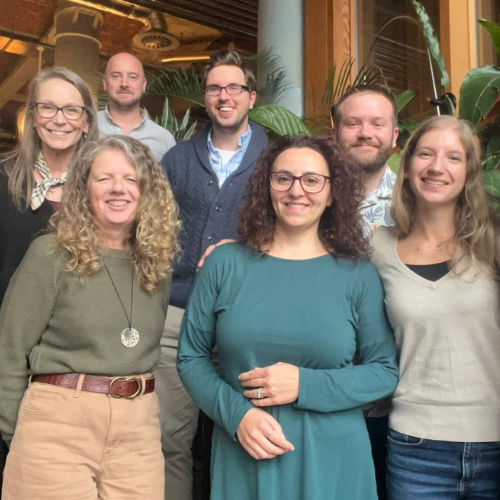
The A-Team (back row: Anna, Jim, Alex, and Rhys; front row: Clare, Steffi, and Joanna)
You can use the live chat button during UK business hours, or click the envelope to leave us a message when we’re not in the office. Plus, you can also use our Get a Quote button at the top of the website for a quick price estimate.
Can I Trust Atlas Translations?
Atlas Translations is certified to ISO 9001:2015 (Quality Management) and ISO 17100:2017 (Translation Services) standards. For confidential projects, we’re happy to sign a non-disclosure agreement (NDA). Registered with the Information Commissioner’s Office (ICO) for over 20 years now, reflecting our long-standing commitment to privacy and data protection.
We’re proud to provide fast, friendly, high-quality services—but don’t just take our word for it. Check out our client testimonials and TrustPilot reviews.
Global Voice, Local Touch
If you’re looking for some top tips for partnering with Atlas Translations, we have some top tips to share! We answer 25 of our clients’ most frequently asked questions, ranging from typesetting queries to discussing reference materials.
Click to download Global Voice, Local Touch