Basque translation
Basque is unlike any other language in Europe, and we mean that quite literally. It is the only language spoken in western Europe that has no known relationship to any other language, living or dead, anywhere in the world. Linguists call it a language isolate, and despite centuries of determined effort, nobody has ever convincingly explained where it came from. We only know that it was already being spoken in the western Pyrenees long before Latin, Greek, or any Indo-European language existed in the region. If you are looking for a translation partner who finds that kind of thing as interesting as you do, you’re in the right place.
A language that could have died, but hasn’t
The survival of Basque is, by any reasonable measure, extraordinary. Sandwiched between Spanish and French for centuries, subject to periods of active suppression, spoken by a relatively small community in a corner of Europe that has seen Roman conquest, Frankish expansion, and Napoleonic reorganisation come and go. Yet here it is, very much alive, with a thriving literary culture, a generation of confident young native speakers, and a regional government that takes its promotion seriously.
The darkest chapter came under Franco’s dictatorship in Spain, when Basque, alongside Catalan and Galician, was banned from public life. The recovery since Spain’s transition to democracy has been remarkable. A standardised written form, Euskara Batua (Unified Basque), was developed and adopted, immersion schools known as ikastolak spread across the Basque Country, and today Basque is co-official alongside Spanish in the Basque Autonomous Community and Navarre. It is a story of genuine resilience, and the Basque-speaking community is understandably proud of it.
Where Basque is spoken
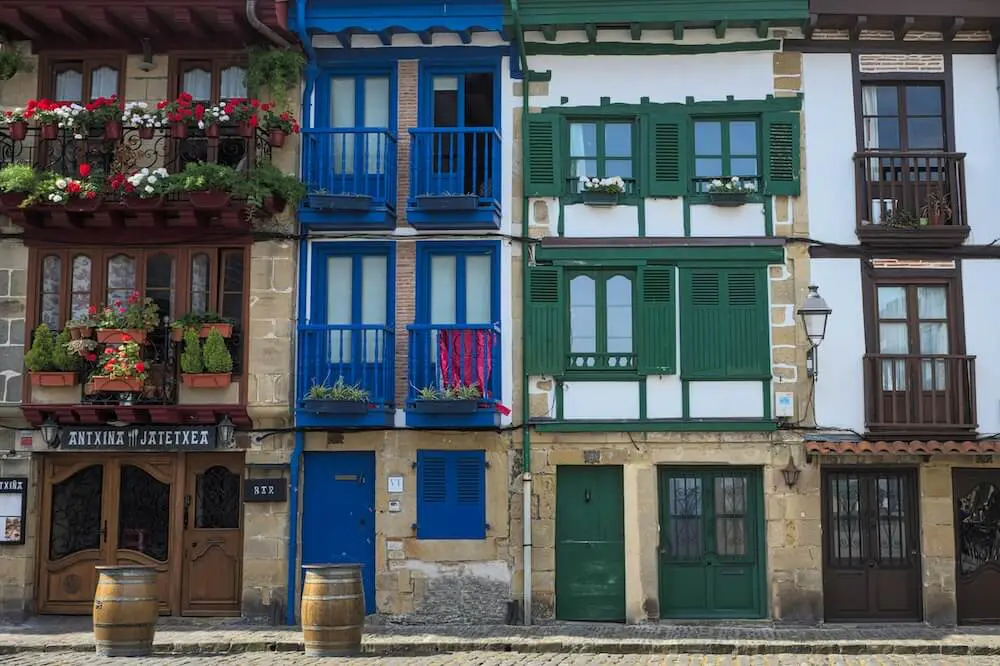
The Basque Country, known in Basque as Euskal Herria, straddles the western Pyrenees across both Spain and France. Total speakers worldwide number somewhere between 750,000 and 1.2 million, depending on whether you count fluent first-language speakers only or include those with partial proficiency.
The Basque Autonomous Community in northern Spain, comprising the provinces of Álava, Gipuzkoa, and Bizkaia, is the heartland. With a population of around 2.2 million, it is one of Spain’s wealthiest regions, and Basque is co-official here alongside Spanish, with significant investment in its use across public life and education.
Navarre, also in northern Spain, has a more complex picture. Basque is spoken primarily in the north and centre of the region, with co-official status only in those Basque-speaking areas rather than across the whole community.
The French Basque Country, the Pays Basque, comprises the three historical territories of Labourd, Soule, and Lower Navarre in the southwestern corner of France. Around 80,000 to 100,000 people speak Basque here, though it has no official status in France. Speakers tend also to be fluent in French, and often in Spanish too.
The Basque diaspora is worth knowing about. Significant Basque emigration — particularly to Latin America and the United States — took place in the 19th and early 20th centuries. Nevada, Idaho, and California have notable Basque-American communities, and Argentina, Uruguay, and Chile all have Basque heritage populations. The Basque government actively maintains relationships with these communities through a global network of cultural centres known as euskal etxeak (Basque houses).
A note on dialects
Before Euskara Batua was standardised in the 1960s and 70s, Basque existed as a collection of regional dialects (Bizkaian, Gipuzkoan, Lapurdian, Souletin, and others) that were sometimes quite different from one another. For most business, legal, and official purposes, Euskara Batua is the right choice today. But for communications aimed at specific local communities, particularly in the French Basque Country or in areas with strong dialect traditions, knowing your audience is key. It is something we will always discuss with you before a project begins.
“I am a will writer and had taken will instruction from an elderly lady, who has poor eyesight and limited English skills. Atlas translated the Will I had written into Italian for me, certified the translation and then Visited with me to see my client at her home and read over the Will in Italian so that my client could understand it properly.
This service was so professional, the interpreter was delightful and skilled and my client was happy to sign the Will and I was confident that she completely understood it which is my job. Atlas and Ilenia the interpreter were fantastic and I shall use them again if required.”
Why translate your documents into Basque?
It is a legal and practical requirement for public-sector work
If you are tendering for contracts with the Basque regional government, producing materials for schools or public institutions, or operating in any regulated public-facing capacity in the Basque Autonomous Community, Basque-language versions are not optional.
It signals respect
The Basque-speaking community has fought hard for its language and notices when outside organisations make the effort. A business that produces materials in proper, natural Basque makes a statement about how seriously it takes the region. One that does not, or that produces obviously poor-quality Basque as a token gesture, also makes a statement: a rather different one.
Spanish alone will not always get you where you need to go
In the most Basque-speaking parts of Gipuzkoa and Bizkaia, and in communities where the ikastola system has produced a generation of confident first-language speakers, Spanish-only communication can feel tone-deaf. Not everywhere, and not always, but enough to be worth thinking about carefully.
The diaspora is engaged and culturally connected
Basque cultural organisations and community groups exist across Latin America, the US, and beyond. For organisations trying to reach this community, Basque-language content creates an immediate connection.

Why trust Atlas with your Basque translation?
Basque is one of the most linguistically distinctive and professionally demanding languages we work with, and one where the difference between a genuine specialist and an inadequate generalist is immediately apparent to any native reader. It is not a language to approach without real expertise, and it is not one where we would ever offer anything less.
Genuine specialists, not generalists
Our Basque translators are native speakers who grew up in the language: educated through the ikastola system or equivalent, and using Basque in their professional and daily lives. Machine translation tools perform poorly with Basque. The language simply does not yield to systems trained primarily on closely related families, and we do not use them as a substitute for human expertise.
We know the Basque market
The Basque regional government’s language requirements, the specific conventions of public sector and legal Basque, the differences between Euskara Batua and the traditional dialects, the distinct character of the French Basque Country. These are things our team understands from experience, not from reading about them.
A named project manager on every job
Every Atlas project is led by a dedicated member of our team who takes ownership of your work from the first conversation to final delivery. You will always know who to call, what is happening with your project, and when to expect it. The Basque public sector and regional institutions have specific expectations around quality and process, and our project management is designed to meet them.
ISO-certified quality you can rely on
Atlas holds ISO 9001:2015 (Quality Management) and ISO 17100:2017 (Translation Services) certifications, which is key to our quality management processes. For clients working in public sector procurement, legal contexts, or regulated industries in the Basque Country, these credentials matter and are frequently required.
Why trust Atlas Translations?



Read more about our commitment to quality
Certified translations by certified humans

Frequently asked questions
How much does Basque translation cost?
Projects vary in need, length, and complexity. If you’re interested in our services and need a fast cost estimate, use our price calculator. Alternatively, you can request a quote or call us to talk it through on 01727 812 725.
How long does it take?
How long is a piece of string? It really depends.
It’s best to give us a call on 01727 812 725 to discuss your project and we can give you a more precise timeframe. We are known for our speedy turnarounds, though…
Do you work with any language?
Looking for more than just Basque?
We are confident that we have your needed language covered. From American English to Zulu, we’ve worked on more than 340 languages since 1991, including Latin and Ancient Greek. Read more about the languages we offer.
How do I know I can trust Atlas Translations?
Atlas Translations holds two ISO certifications — ISO 9001:2015 (Quality Management) and ISO 17100:2017 (Translation Services). If the project is confidential, we can sign NDAs for extra peace of mind.
Are you wondering if we’re up to date on privacy? We registered with the Information Commissioner’s Office (ICO) over twenty years ago, and we have always prioritised data protection.
Rad more about our commitment to quality.
Atlas Translations are here to support you. Whether you’re an individual, a SME or a multinational corporation, we can help.
Have a Basque project to discuss, or wondering whether Basque translation should be part of your plan?
Email us on team@atlas-translations.co.uk
Call us on 01727 812 725
Tell us some details and get a quote
Use the chatbox to start a conversation. It’s a real-life human, no bots here! (During UK business hours – we do need to sleep.)
See more options on our contact page.