
Posted on27 January 2026
From Patients to Participants: Why Multilingual Health Information Is No Longer Optional

Healthcare has changed. Patients are no longer passive recipients of care, following instructions without question and then trotting off to the nearest pharmacy. Today, they research symptoms, compare treatment options, question recommendations, and take an active role in nearly all decisions about their health. In many cases, this involvement requires multilingual health information.
Why is that? It’s because patients have become healthcare customers. And like any informed customer, they expect clear, accurate health information they can understand and trust. That expectation is not going to change when it comes to the language used.
What can we help with today? Call us on +44 (0)1727 812 725 or email us at team@atlas-translations.co.uk – we’re only a call, chat, or email away, and we’re always eager to help!
Patients Are No Longer Passive Recipients of Care
Digital access to health information, patient portals, and online communities has reshaped how people interact with healthcare systems. Patients are now notetakers, arriving informed, curious, and ready to engage in conversations about their care.
This shift brings real benefits. Engaged patients are more confident, more likely to ask questions, and better positioned to make decisions aligned with their needs and values. In this environment, health information plays an informational role, supporting comparison, understanding, and trust.
But this only works when information is genuinely accessible. If patients cannot fully understand what they are being told, their ability to participate meaningfully in their care is reduced.
Healthcare Literacy Needs Multilingual Understanding, Not Just Information
Health literacy is often misunderstood as simply providing information, when in reality it’s about whether that information can be understood, trusted, and used.
Organisations such as the Patient Information Forum have long highlighted the importance of producing health information that is clear, reliable, and centred on patient needs. Their work reflects a simple truth: information that exists but cannot be understood still fails in its purpose.
As healthcare communication becomes more patient-centred, understanding matters just as much as availability. Multilingual health information is needed across patient leaflets, consent forms, websites, clinical trial materials, and public health campaigns.
Where Language Becomes a Barrier to Informed Choice
For many patients, English is not their first language. Others may use English confidently in daily life (the weekly food shop, or taking the bus) but struggle with medical terminology, complex explanations, or unfamiliar healthcare processes.
In these situations, language can quickly become a barrier. Important details may be misunderstood, risks may not be fully grasped, and confidence in decision-making can be undermined.
This isn’t simply a translation issue. It’s a health literacy issue.
When patients are expected to engage with healthcare information as informed participants, language access becomes part of responsible communication. Without it, the move toward patient empowerment risks excluding those who already face language barriers.
Why “Plain English” Isn’t Always Enough
Providing health information in “plain English” continues to play an important role in improving clarity, but clarity in one language does not automatically transfer to another.
Let’s say a patient were to read these notes from a recent visit to their GP:
“Persistent poor nutritional intake combined with physical inactivity markedly increases the likelihood of an adverse cardiovascular event, including fatal myocardial infarction, mediated by exacerbation of atherosclerotic plaque burden, endothelial dysfunction, and cardiometabolic derangement.”

or, they read:
“If the patient doesn’t eat better and exercise more, they’ll die of a fatal heart attack sooner, and not later.”
As uncomfortable as it is, I know which one I’d prefer to read.
The problem is that medical concepts, cultural expectations, and tone vary widely across languages and healthcare systems. What works for “plain English” in one setting may not translate cleanly into another. A literal translation can technically convey the words on the page, yet still fail to communicate meaning.
Effective translation considers:
- Medical accuracy and terminology consistency
- Cultural context and patient expectations
- Tone that supports reassurance and trust
- Language that reflects how healthcare is discussed locally
This is particularly important for patient-facing materials, where misunderstanding can affect agreement, following of instructions, and confidence in care.
Sector-Specific Translation as Part of the Multilingual Health Information Ecosystem
And so, as patients take a more active role in healthcare decisions, translation is going to work best when it is treated as part of the wider health information ecosystem, not a final administrative step.
High-quality translation should easily support:
- Informed consent by making options and risks clear
- Patient confidence by reducing uncertainty
- Trust in healthcare providers and organisations
- Consistency across multilingual patient materials
For organisations producing healthcare communications at scale, translation will be most effective when planned as a part of content development, review, and quality assurance.
This is where sector-specific experience matters. Translators who understand healthcare communication, patient-facing tone, and regulatory expectations help preserve clarity across languages without diluting meaning or intent.
Supporting Better Patient Decisions Through Multilingual Understanding
When patients understand their options, they are better equipped to engage with care, ask informed questions, and make decisions aligned with their needs. This leads to better experiences for patients and clearer communication for healthcare providers.
- Language plays a quiet but critical role in this process. It shapes how multilingual health information is received, how confident patients feel, and how effectively they can participate in their own care.
- Interpreters are an important and valid part of this process. But, there are times when a patient doesn’t want a complete stranger listening to or translating their physical or mental diagnoses.
- What about a friend or family member helping out with translation? Certainly, this is a (possibly) more comfortable solution than a stranger. But it’s a safe bet all of us can think of a situation we’d rather not have our Mum, Dad, or Cousin involved in! 😳
As healthcare continues to evolve toward a more customer-centric model, the demand for clear, accessible, and multilingual patient information is only going to increase.
It’s a Wrap!
The shift from passive patient to active healthcare customer brings new responsibilities for organisations creating health information. Providing accurate content is no longer enough. That content must be understood in every way.
Health literacy does not end with the English language. For healthcare communication to truly support informed participation, language access must be considered from the start.
By treating translation as an integral part of a multilingual health information strategy, organisations can support understanding, build trust, and help patients take an active role in their healthcare decisions, whatever language they speak.
We’d Love to Hear From You!
You can call us on +44 (0)1727 812 725 or email team@atlas-translations.co.uk. We respond quickly to all enquiries and are always happy to chat about your needs.
If you’d like to visit us in person to learn more about our services or to drop off documents, just give us a call or email us to arrange a time.
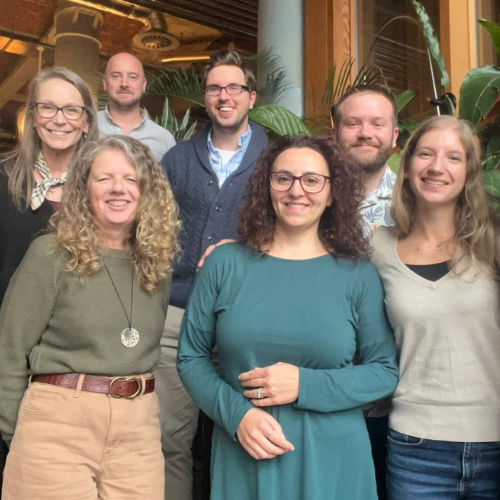
The A-Team (back row: Anna, Jim, Alex, and Rhys; front row: Clare, Steffi, and Joanna)
During UK working hours, you can also use our Live Chat option (bottom right of the screen). A real person, not a bot, will always connect with you!
And if you need a fast estimate, our Get a Quote button at the top of the website makes it easy
Can I Trust Atlas Translations?
Atlas Translations is certified to ISO 9001:2015 (Quality Management) and ISO 17100:2017 (Translation Services) standards. For confidential projects, we’re happy to sign a non-disclosure agreement (NDA).
Registered with the Information Commissioner’s Office (ICO) for over 20 years now, reflecting our long-standing commitment to privacy and data protection.
We’re proud to provide fast, friendly, high-quality services—but don’t just take our word for it. Check out our client testimonials and TrustPilot reviews.
Global Voice, Local Touch
If you’re looking for some top tips for partnering with Atlas Translations, we have some top tips to share! We answer 25 of our clients’ most frequently asked questions, ranging from typesetting queries to discussing reference materials.
Click to download Global Voice, Local Touch