
Posted on24 March 2026
Terminology Management: The Secret Weapon Behind Consistent Medical Translations

In a translated document, consistency sounds like a basic expectation. But for organisations managing large volumes of regulated documents across multiple languages, achieving that consistency is harder than it sounds. Understandably, the gap between “probably fine” and “demonstrably consistent” can have real consequences.

Terminology management is the discipline that closes that gap. It’s used across many industries where precision matters, from legal and financial services to technical documentation and software localisation. But nowhere are the stakes higher, or the systems more important, than in medical and pharmaceutical translation. This week, that’s exactly the area we’re going to focus on.
What can we help with today? Call us on +44 (0)1727 812 725 or email us at team@atlas-translations.co.uk – we’re only a call, chat, or email away, and we’re always happy to help!
What Terminology Management Actually Means
At its core, terminology management relies on two tools working together.
The first is a glossary (also called a termbase or project dictionary): a client-approved list of preferred terms and their translations across target languages. This covers product names, dosage forms, regulatory language, and much more. It’s a tool to help an organisation use industry-specific terminology consistently across all documents.
The second is translation memory (TM): a database that stores previously translated segments and surfaces them when similar content appears again. If a sentence has already been translated and approved, the TM makes sure it’s rendered the same way the next time it appears, regardless of which translator is working on the project.
These are assets that belong to the client and grow more valuable with every project.
Why Good Terminology Matters in Medical Translation
In regulated industries, especially in medical translations, terminology consistency is both a quality preference and a practical requirement.
Regulatory submissions depend on exact alignment across documents. A term used one way in a clinical trial protocol cannot appear differently in a patient information leaflet or an investigator brochure. If it does, the discrepancy will be noticed, and it will need to be explained or corrected before the submission moves forward.
Clinical trial materials are reviewed by multiple bodies, sometimes across multiple countries. Inconsistencies attract scrutiny. Pharmacovigilance and adverse event reporting rely on standardised terminology, where ambiguity can have real downstream consequences.
To illustrate the kind of problem this can cause, imagine a pharmaceutical company submitting documentation for a new drug. Within the documentation, a single term has been translated two different ways across three documents.
Each translator made a reasonable decision in isolation because they worked without a shared glossary. The regulatory reviewer flags the discrepancy. The submission is delayed while the documents are corrected and re-reviewed. The fix is straightforward, but the time and resource costs are high and entirely avoidable.
The Problem With Starting From Scratch Every Time
Without a managed glossary and translation memory in place, every new project carries risk. A new translator makes different decisions from the last one. Review cycles get longer because the client has to revisit terminology they thought was settled. Errors compound over time rather than being locked out at the start.
This is a challenge across the industry. Even organisations with strong internal processes can struggle when working with translation partners who don’t maintain client assets between projects. When there’s no continuity of terminology from one project to the next, consistency has to be rebuilt from scratch each time.
How a Long-Term Agency Relationship Changes the Equation
A well-structured terminology management workflow looks like this: the agency builds a glossary from day one, capturing every client decision as it’s made. Translation memory accumulates across projects, so returning clients aren’t paying to re-translate material they’ve already reviewed and approved. Terminology assets are reviewed and updated as products evolve, regulations change, or new markets are added.
This kind of infrastructure takes time to build. That’s precisely why it rewards a stable, ongoing relationship with a single professional translation service rather than switching providers between projects.
As a hypothetical example: a clinical trials team that works with the same agency across multiple studies arrives at submission time with a fully consistent document set, because the terminology decisions were made and documented at the start of study one. Each subsequent project builds on that foundation rather than starting from scratch 😭.
Not Just a Medical Translation Challenge
While this post has focused on pharmaceutical and medical translation, the same principles apply wherever precision matters.
Legal translation, financial services, and technical documentation all benefit from well-maintained glossaries and translation memory. The difference in regulated medical contexts is the addition of patient safety and regulatory compliance into the equation. Because of this, the systems need to be more rigorous and the assets more carefully maintained.
What This Means for Your Projects
What about you? Are you managing recurring translation projects? Are you relying on memory or a random Google doc rather than documented terminology assets? If you’re doing that, there’s a risk building quietly in the background.
The good news is that the risk is straightforward to fix. Even better, the fix is an asset that becomes more valuable the earlier you start.
Would you like to understand how terminology management works in practice? Or what building a terminology management asset from your very first project could look like, we’d be thrilled to talk it through with you!
Contact Us Today!
You can call us on +44 (0)1727 812 725 or email team@atlas-translations.co.uk. We respond quickly to all enquiries and are always happy to chat about your needs.
If you’d like to visit us in person to learn more about our services or drop off documents, just call or email us to arrange a time.
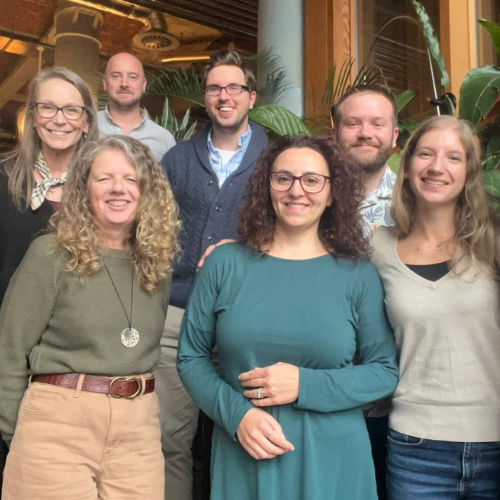
The A-Team (back row: Anna, Jim, Alex, and Rhys; front row: Clare, Steffi, and Joanna)
You can use the live chat button during UK business hours, or click the envelope to leave us a message when we’re not in the office. Plus, you can also use our Get a Quote button at the top of the website for a quick price estimate.
Can I Trust Atlas Translations?
Atlas Translations is certified to ISO 9001:2015 (Quality Management) and ISO 17100:2017 (Translation Services) standards. For confidential projects, we’re happy to sign a non-disclosure agreement (NDA). Registered with the Information Commissioner’s Office (ICO) for over 20 years now, reflecting our long-standing commitment to privacy and data protection.
We’re proud to provide fast, friendly, high-quality services—but don’t just take our word for it. Check out our client testimonials and TrustPilot reviews.
Global Voice, Local Touch
If you’re looking for some top tips for partnering with Atlas Translations, we have some top tips to share! We answer 25 of our clients’ most frequently asked questions, ranging from typesetting queries to discussing reference materials.
Click to download Global Voice, Local Touch