Danish translation
With over 5 million native Danish speakers and 10 million second-language speakers worldwide, translating into Danish can help you tap into a lucrative European market. Denmark’s rich culture, history of innovation, and liberal values make it an attractive market for businesses looking to expand. Professional translation into Danish can open doors to new opportunities and help you connect with your target market on their terms.
The Danish language
Speak (sort of) with your Nordic neighbours
The close linguistic bond between Scandinavian languages means that speakers of these languages can often understand each other to a limited extent. Imagine a Dane, a Swede, and a Norwegian sitting down for a chat. The conversation might include clarification and some rephrasing, but you can definitely achieve basic communication.
Three extra letters? No problem
Crack open a Danish book, and you’ll see something unfamiliar: three extra letters nestled amongst the familiar A to Z. These aren’t fancy symbols; they’re the heart and soul of many Danish words: Æ, Ø, and Å. Pronounced roughly like the ‘a’ in ‘care’, the ‘eu’ in ‘feud’, and the ‘aw’ in ‘saw’, respectively, these vowels add a unique twist to the Danish language across cultures.
A land flowing with vowels
Speaking of vowels, the Danish language is positively overflowing with them. Compared to English’s five vowels, Danish boasts a cool nine of them, and mastering their pronunciation can be a challenge. The ‘ø’ in sø (lake) sounds completely different from the ‘ø’ in gøg (cuckoo).
Fascinating facts
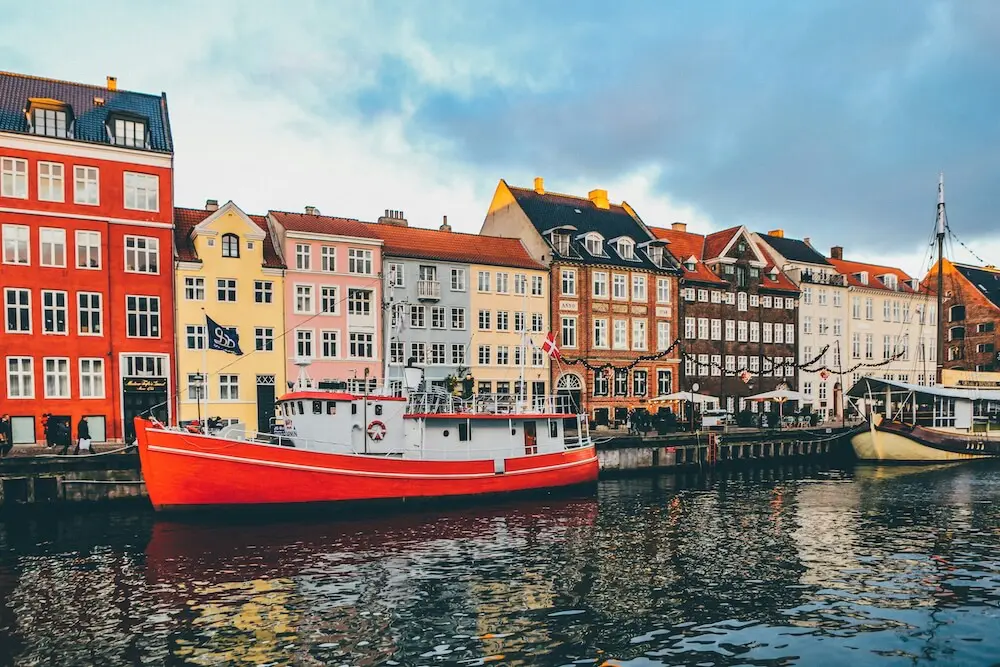
- The familiar Danish flag (red with an off-centred white cross) is named the ‘Dannebrog’, meaning ‘Danish cloth’. The Dannebrog flies on nearly every occasion, especially birthdays, and holds the record for the oldest continuously used national flag (since 1219).
- Have you noticed how the Danish royal family only uses the names Christian and Frederick for their monarch? The names are used repetitively as each king (or queen) accedes the throne. In the case of Queen Margrethe II, the decision was made that she would assume the instance of Christian. Her firstborn son would have the name Frederick, and so we have the current King Frederick X.
- Danish isn’t just spoken in Denmark. Greenland is an autonomous territory within the Kingdom of Denmark, where roughly 10% of the population speaks Danish as a second language. However, it’s important to note that the primary language of Greenland is Kalaallisut, an ancient Inuit language.
- Denmark is a cycling haven. The first bike lane was established in 1892 in Copenhagen. Today, there are 385 kilometres (239 miles) in the city, and the network of national cycle routes spans 4,770 kilometres (2,963 miles) across all of Denmark.
- Calling all Lego fans! This iconic building block was born in Denmark in 1932. The name ‘Lego’ is derived from the Danish phrase leg godt, which means ‘play well’. The city of Billund in Denmark is home to Legoland, a theme park dedicated to all things Lego.
- The Danish pastry is not Danish! It was created in France in 1622 and then taken to Italy and Austria. It only arrived in Denmark in 1840, after a strike of Danish bakers forced bakeries to hire Viennese replacements who started producing the pastry. This is why the Danish call it wienerbrød or Vienna bread.
Key industries in Danish-speaking markets
Shipping and maritime
Denmark is one of the world’s great maritime nations. The Maersk Group, headquartered in Copenhagen, is the largest container shipping company on the planet. Denmark’s maritime cluster, encompassing shipping, ship design, marine engineering, and port logistics, is world-leading, and the documentation needs of this sector are extensive and highly technical.
Pharmaceuticals and life sciences
Denmark has a remarkable concentration of pharmaceutical and biotech companies for a country of its size. Novo Nordisk, one of the world’s largest pharmaceutical companies and the dominant global supplier of insulin, is Danish. So is Leo Pharma, and a thriving ecosystem of biotech firms clusters around Copenhagen and Aarhus. This is a sector with exacting translation requirements where precision is everything.
Renewable energy
Denmark is a world leader in wind energy, both onshore and offshore. Vestas and Ørsted are Danish companies that have shaped the global wind industry, and Denmark’s expertise in renewable energy is exported, along with its engineers, contractors, and documentation, around the world. If you are working anywhere in the wind energy supply chain, there is a good chance Danish will come up sooner or later.
Food and agriculture
Denmark is a major food exporter, particularly in pork, dairy, and processed foods. Danish agricultural cooperatives are large, sophisticated organisations, and the country’s food industry has a global export footprint that generates steady translation demand across labelling, certification, and commercial documentation.
Design and architecture
Danish design has a global reputation built on a philosophy of simplicity, functionality, and craftsmanship. From furniture to consumer electronics to urban planning, Danish design firms work internationally and produce materials that frequently need translation in both directions.
Financial services
Copenhagen is a significant Northern European financial centre, home to major banks, pension funds, and investment managers. Denmark’s financial sector is well-developed, internationally connected, and subject to both Danish and EU regulatory frameworks.
Technology and software
Denmark has a healthy technology sector, with particular strength in healthtech, cleantech, and maritime technology. Copenhagen has developed a startup ecosystem, and Danish tech companies with international ambitions need materials that work in multiple languages.

“I was particularly impressed with the speed in which you turned the work around, and the quality of the work was excellent. Many thanks. It was a pleasure working with you.”
Why translate your business materials into Danish?
High English proficiency does not mean English is preferred
This is the point that surprises people most about translating into Danish. Yes, most Danes speak excellent English. But research consistently shows that consumers, even highly multilingual ones, make purchasing decisions more comfortably, understand terms and conditions more clearly, and trust brands more readily in their native language. English proficiency is not the same as English preference.
Legal and regulatory requirements apply regardless
In many sectors, Danish-language documentation is a legal requirement rather than a choice. Consumer contracts, product labelling, financial disclosures, and employment documentation all carry language obligations in Denmark, whatever the linguistic abilities of the people involved.
B2B relationships are built on detail
In technical sectors like maritime, pharmaceuticals, and energy, the documents that matter most are technical specifications, contracts, and safety documentation. Getting these right in Danish, rather than relying on imperfect English comprehension, is a straightforward risk management decision.
The Scandinavian market
The Scandinavian market is often approached as a block and Danish is the key to Denmark, which is frequently the entry point. A business that cracks Denmark often finds the rest of the Nordic region more accessible as a result.
Why trust Atlas with your Danish translation?
Denmark’s high English proficiency can lull businesses into thinking Danish translation is not particularly important. And then they work with a Danish partner or try to sell into the Danish consumer market and realise quickly that it is. Atlas has been providing Danish translation for years, and we understand the market as well as the language.
Native Danish translators with sector expertise
Whether your project involves pharmaceutical regulatory documentation for the Danish Medicines Agency, technical materials for the wind energy sector, maritime documentation, or consumer content for the Danish retail market, we will match you with a translator who knows the field, not just the language.
Dedicated project management
Every project at Atlas is owned by a named project manager who is responsible for quality, timeline, and client communication from start to finish. You will always have someone to call.
ISO 9001:2015 and ISO 17100:2017 certified
We were one of the first UK translation agencies to achieve ISO 17100, and these standards underpin every project we deliver, including in Danish, where precision in technical and regulatory contexts is particularly critical.
A full range of services
Danish translation, proofreading, interpreting, subtitling, voiceover — if your Danish project has multiple components, we can manage them all in one place.
Why trust Atlas Translations?


Read more about our commitment to quality
Certified translations by certified humans
Frequently asked questions
How much does Danish translation cost?
Projects vary in need, length, and complexity. If you’re interested in our services and need a fast cost estimate, use our price calculator. Alternatively, you can request a quote or call us to talk it through on 01727 812 725.
How long does it take?
How long is a piece of string? It really depends.
It’s best to give us a call on 01727 812 725 to discuss your project and we can give you a more precise timeframe. We are known for our speedy turnarounds, though…
Do you work with any language?
Looking for more than just Danish?
We are confident that we have your needed language covered. From American English to Zulu, we’ve worked on more than 340 languages since 1991, including Latin and Ancient Greek. Read more about the languages we offer.
How do I know I can trust Atlas Translations?
Atlas Translations holds two ISO certifications — ISO 9001:2015 (Quality Management) and ISO 17100:2017 (Translation Services). If the project is confidential, we can sign NDAs for extra peace of mind.
Are you wondering if we’re up to date on privacy? We registered with the Information Commissioner’s Office (ICO) over twenty years ago, and we have always prioritised data protection.
Rad more about our commitment to quality.
Atlas Translations are here to support you. Whether you’re an individual, a SME or a multinational corporation, we can help.
Need a Danish translation?
Email us on team@atlas-translations.co.uk
Call us on 01727 812 725
Tell us some details and get a quote
Use the chatbox to start a conversation. It’s a real-life human, no bots here! (During UK business hours – we do need to sleep.)
See more options on our contact page.